Graviola is Inferior to Paw Paw for the Purpose of Fighting Cancer. Here is Why.
Introduction
Some unscrupulous (as well as some well-meaning--but uninformed) companies and their vendors attempt to pass off a graviola supplement product as equivalent to paw paw. In fact, some companies go so far as to call their product "Paw Paw"--attempting to capitalize on the good name of paw paw--even at times justifying their deception by saying that graviola is sometimes called "Brazilian paw paw." Graviola is also known by other names, such as "guanabana" and "soursop".
The reported use of graviola as an anti-carcinoma treatment has gone back for decades. While some people have no doubt seen some success with graviola, it is important to note the differences and understand why it is not even close to equivalent with paw paw when used for this purpose.
Tests were done under the direction of Dr. Jerry McLaughlin on two leading graviola products on the market. The first one had a cyto-toxic potency level of about 4% of the potency of paw paw--in other words, paw paw had about 24 times the potency of this product. The second leading graviola product had a potency level of 2% that of paw paw; so paw paw was about 50 times as potent as that product. These results should be unacceptable to those serious about using a product of this nature to fight cancer.
As will be further explained below, there are two big differences between graviola products and paw paw. First, and probably most important, is the chemistry structure. The chemistry structure of the graviola compounds does not allow it to be as potent as that of the paw paw acetogenins. Second, the manufacturing process of graviola products is inferior in that it is generally consists of grinding powder from leaves, twigs, or other parts of the plant. With this type of very unsophisticated manufacturing process, the amount of active acetogenins will vary widely by batch, and the amount in any selected bottle is unknown to the consumer.
Dr. McLaughlin, while known for his work with paw paw, also did testing of graviola during his long research career. He not only isolated the acetogenin compounds in paw paw that have been seen to fight cancer, but he also found the compounds in graviola and is an expert on the differences. He did two separate research projects on graviola leaves, twigs, and seeds, and isolated 28 acetogenin compounds from that plant.
He has written about these compounds in many papers (over 300 total!) that he published, most of them published in prestigious publications such as the Journal of Natural Products, Heterocycles, Journal of the American Chemistry Society, Phytotherapy Research, Journal of Organic Chemistry, Journal of Medicinal Chemistry, and others. Several of these papers note the chemical differences between the acetogenins found in the two species, and discuss what makes those in paw paw much more powerful.
The Scientific and Physical Distinction
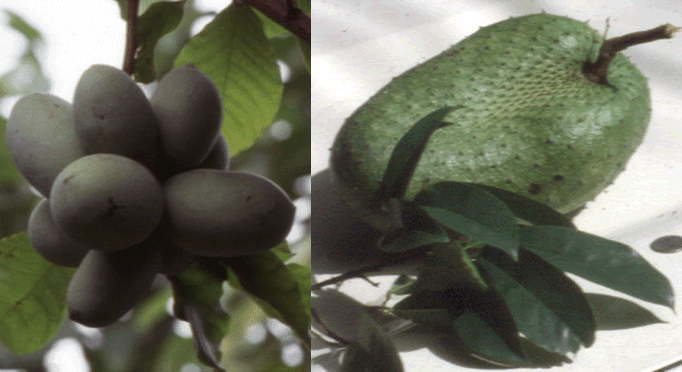
The scientific name of the paw paw used by Dr. McLaughlin in his research is Asimina triloba. It is a North American species of paw paw. Although botanically, the paw paw and graviola are related (both are of the Annonaceae family), they are not the same--any more than an apple and a pear are the same. The scientific name of the graviola is Annona muricata. If one looks at the photographs of the two below, the physical difference is obvious. Paw paw is on the left, and graviola is on the right.
Brief History
In the 1970's, the National Cancer Institute started funding Dr. Jerry McLaughlin at Purdue University to find botanical substances that had anti-cancer potential. He tested and screened over 3500 species of plants, and found that the acetogenin compounds of the Annonaceae family had the most potential. He--along with 13 of his Ph.D. students and others--worked with the various species of this family, including the paw paw and graviola. They found and isolated over 400 acetogenins in this family, and used some very sophisticated chemical modeling techniques to determine and show the differences. About 50 acetogenins were found in the paw paw, and about 30 in the graviola.
Chemistry Differences
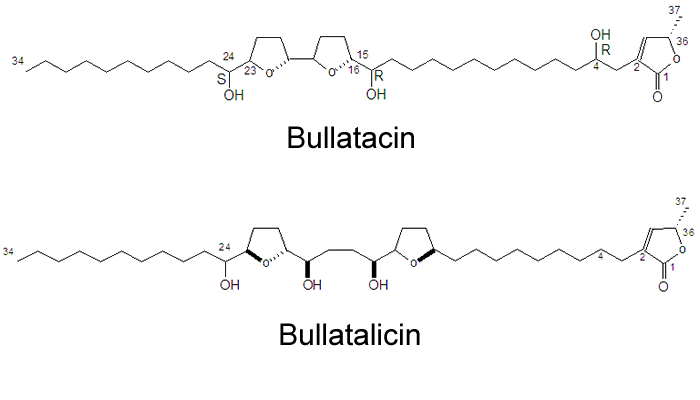
Of more importance than the number of acetogenins found in each plant are the potency of these compounds. Dr. McLaughlin and his students did chemical structure analysis on many of these compounds, and without exception found that those acetogenins with a "double ring" chemical structure were many, many times more powerful than those with only single ring structures. In fact, Dr. McLaughlin went further to isolate "triple" ring structured compounds--only to find that they also were inferior to double ring. The pictures below show 2 different acetogenin chemical structures--both of which are found in paw paw but NOT in graviola. These acetogenins (bullatalicin and bullatacin) have double ring structures. Note the proximity of the two ring structures to each other. All of the acetogenins in graviola do NOT have a double ring structure--only single ring--and this chemical structure causes them to have only a fraction of the potency of paw paw. For reference, it is Bullatacin that was tested by Upjohn Company (now Pfizer) to be 300 times the potency of Taxol, a chemotherapy drug.
Manufacturing Differences
The graviola products on the market typically advertise themselves as "freshly ground powder" of twigs, leaves, etc. This type of manufacturing process has two main advantages for the manufacturer--but not the customer. First, it is cheap to produce. Second, it is easy enough that just about anyone can do it.
However, there are problems--and big ones. Dr. McLaughlin found in his research that the level and potency of the acetogenins--even in paw paw itself--varies according to time of year. In fact, it varies drastically! If the twigs are not harvested during the month of May, they are essentially worthless. Also, the acetogenin potency varies even from tree to tree in the same grove! Again...drastically! The problem remains then, how does the manufacturer guarantee that the customer gets the required acetogenin level in each and every capsule of product?
The answer is standardization. A process must be developed or used by the manufacturer to test every single batch of product produced and determine whether or not the potency level is present. Furthermore, the manufacturing process must be able to allow and compensate for different levels of acetogenins in order to get the proper level in each and every capsule. If the product is made (as are the typical graviola products) simply by grinding up the raw ingredients and putting them into capsules, there is not much way to make any adjustments--after all, you can only fit so much material into the capsule, whether or not it has any acetogenins or not. Thus, graviola manufacturers generally do not standardize their products. This process is not easy, since every single batch of material must be tested and adjustments made.
However, the process for that that Dr. McLaughlin developed for the paw paw uses an extraction of the acetogenins from the paw paw twigs. This process allows the manufacturer to adjust the acetogenin level somewhat to be able to guarantee a set amount in each capsule. Thus, the customer is assured of proper potency.
Much can be said about the differences. If you would like to hear Dr. McLaughlin speak on this directly, check out the Video Q&A page as well as his Powerpoint Presentation elsewhere on this site.